
The AI-Native Stack: Beyond Prompting in the Agentic Era
The chat era was about answers. The agent era is about actions.

In late 2022, the world didn’t fall in love with AI because the models suddenly became smart. The models were already impressive. What changed was access — a chat interface turned advanced capability into something anyone could use. We’re watching that kind of interface-driven shift again; This time from generative AI — which produces outputs — to agentic AI — which completes tasks.
Agentic systems don’t just talk; They can operate a browser, run code, call APIs, install software, manage files, and chain steps toward a goal. Frameworks like OpenClaw — an open-source agent that integrates with everyday channels and executes real actions — are accelerating this by making autonomy accessible to anyone.
Two weeks ago, I watched an agent decide it needed to make a phone call. It didn’t have a voice API. So it found one, downloaded it, connected to Twilio, and called. Nobody told it to do any of that.
This is what people mean when they say “AI got hands.” And the thing that feels most different — the thing that keeps practitioners up at night — is the system’s ability to infer intent. You describe a goal loosely. The system decides what steps to take, what tools to use, and when to act proactively. The experience is closer to collaborating with a capable colleague than to using software.
When the system can take action, the critical skill stops being “write a better prompt” and becomes: architect the environment where the agent operates.
That’s the shift.
After working across several enterprise AI transformations, I’ve come to see this capability as a stack — four tiers, each building on the previous. I call it the AI-Native Stack.
🔧 Tier 1 — TOOLS: Selection & Orchestration
Most organizations start by standardizing on one AI tool: Copilot, ChatGPT, Claude. It’s a rational first move — but it’s like equipping surgeons, carpenters, and chefs with the same Swiss Army knife and expecting them all to thrive.
Every department has different functions, different objectives, and different risk profiles. Ethan Mollick’s research on the “jagged frontier” is instructive: the boundary of what AI can and can’t do is irregular and unpredictable, and it shifts depending on the specific tool and the specific task. A model that writes excellent marketing copy may be useless for financial analysis. A code-generation tool may fail at design.
The first skill is selection: understanding the landscape, matching tools to functions, and making deliberate choices instead of defaulting to whatever the enterprise license covers.
The greater skill is orchestration — and it operates at two levels.
Task-level orchestration is routing: when do you call a lightweight model vs. a frontier model? A calculator vs. a code interpreter? A local model for privacy vs. a cloud model for power? Each tool has a cost, latency, and reliability profile. The skill is matching the cognitive demand of each task to the most efficient tool that can handle it. Power users don’t prompt better. They route better.
Work-level orchestration is new — and it changes how you spend your day. Agentic AI can now work autonomously for 30+ minutes on complex tasks. That means you stop waiting for “the answer” and start launching multiple workstreams in parallel, monitoring progress, providing course corrections, integrating outputs. You become a conductor, not a single player.
A developer recently built what amounts to a full virtual studio this way: specialized sub-agents for design, engineering, product, marketing, and operations — each with its own role, constraints, tools, and success metrics. No prompts. No babysitting. You describe the task. The right agent activates. This is how solo founders are starting to scale without hiring, and the architectural pattern applies equally inside large organizations.
OpenClaw provides one scaffolding for this kind of orchestration. It’s open source, it comes from what I’d call a “time-abundant, not capital-abundant” mindset, and its library of connectors grows by the day. Whether or not OpenClaw specifically endures, the pattern it represents — open, composable orchestration of AI agents — is the future.
📊 Tier 2 — CONTEXT: Context Engineering & Data Readiness
Here’s a mental model worth sitting with: AI models are commoditizing fast. Open-source models are closing gaps with commercial ones. New releases leapfrog each other continuously. At some point, you become the bottleneck — the difference between a genius and a super-genius physicist is irrelevant if you can’t follow either one.
So if the model isn’t the moat, what is?
Context.
Not just “documents in a folder,” but: your constraints, your definitions of success, your style rules, your risk posture, your organization’s vocabulary, your strategic priorities, your truth sources.
This is what I we call Context Engineering — the discipline of providing AI with everything it needs to deliver value to you specifically. It goes far beyond uploading files.
RAG (retrieval-augmented generation) was a start. The direction now is structured, portable context: knowledge packages that encode how work should be done in your environment. These are the .MD Markdown files; modular, versioned, machine-readable files — and the most advanced systems can identify which packages they need based on the task at hand, without you specifying anything.
But there’s a deeper layer that most organizations are about to learn the hard way: agentic AI will expose your data readiness.
If your organization’s knowledge is scattered, duplicated, contradictory, or locked in silos, the agent won’t become “smart.” It will become confidently chaotic. Context engineering at the organizational level means linking your data richly, organizing it semantically, and maintaining it as a living asset. Knowledge graphs, ontologies, structured data architectures — these aren’t academic exercises. They’re what determines whether your AI produces reliable insight or expensive nonsense.
A practitioner I respect recently described the experience of connecting an agent to a properly structured ontology and knowledge graph. His words: the speed with which organizational complexity became usable leverage was “both exhilarating and unsettling.” He’s right. And he looked slightly manic when he said it.
The winners will be the teams who can assemble context quickly, structure it cleanly, and keep it current. Context is king.
⚙️ Tier 3 — LOGIC: Workflow Engineering
Generative AI produced outputs. Agentic AI executes processes.
This is the shift from imperative prompting (”do step 1, then step 2, then step 3”) to declarative intent (”here’s the outcome, the constraints, and the success metrics — figure out the steps”).
A personal example. I scan AI news daily. My old process was mostly manual: collect articles, send them to a private WhatsApp group, categorize them with my own tagging system, read them when I had time, extract insights and quotes — always tagged with source. With visual tools like n8n, I could have designed an automation workflow. But I’d still need to specify every node and connection.
Now I declare: “Classify incoming articles with these tags. Extract the least intuitive insights. Send me a summary every three hours.” The AI determines and executes the workflow. Autonomously.
This tier has four dimensions:
Business logic — the rules, constraints, and decision criteria specific to your context. “We never discount more than 15%.” “All content needs legal review.” These rules live in people’s heads or scattered documents. Making them explicit and machine-readable is foundational.
Guidelines — the guardrails for AI behavior specifically. What it should and shouldn’t do. Quality standards. Edge case handling. Failure modes and fallbacks.
Workflows — the actual sequences of steps, whether designed by humans, proposed by AI, or co-created. The critical point: if you don’t understand the workflows your AI is executing, you’ve become a consumer, not a collaborator. You can’t improve what you can’t see. This is why I believe workflow visualization — canvases where we can inspect, edit, and audit AI-generated processes — will become one of the most important tool categories in the next two years.
Coordination — how workflows interact across roles, teams, and departments. Designing a workflow for one person is relatively straightforward. Designing workflows that coordinate across an organization — with handoffs, dependencies, and conflicting priorities — is an order of magnitude harder. And it’s where the largest value lives.
Now here’s the insight I think most people miss: Automation isn’t the breakthrough. Measurement is.
That developer who built a virtual studio of sub-agents? The reason it works isn’t the AI. It’s that each agent has clear success metrics. You know what “done well” looks like for the brand guardian, the backend architect, the growth hacker.
Most AI implementations fail not because the technology doesn’t work, but because teams never define success. They build impressive demos. They generate excitement. And then they can’t demonstrate reliable business outcomes, because they never specified what those outcomes should be.
When you force yourself to define success metrics before building the agent, you naturally make better design decisions: clearer roles, tighter constraints, more useful outputs. Without success metrics and observability, you don’t get operations — you get demos.
One more thing. Agentic AI doesn’t just execute workflows you define — it can anticipate needs and act proactively. It sees you’re cooking paella tomorrow and haven’t bought rice. It notices your tire is low and suggests a garage near your planned route. This proactive behavior is what makes the experience feel qualitatively different from anything we’ve had before. And it makes the case for workflow transparency even more urgent: when the AI is taking initiative, you especially need to understand what it’s doing and why.
🧠 Tier 4 — HUMANS: Mindset, Culture & Organizational Redesign
I’ve placed this tier last in the stack, but I want to be direct: it’s the one that matters most, and it’s the one where most transformations stall. Not because the tech doesn’t work, but because the organization wasn’t designed for digital coworkers.
Three realities arrive at once:
Hands-on literacy becomes leadership hygiene. Before you can lead transformation, you need lived intuition. Not demos. Not vendor decks. Weeks of daily use, on your actual work, with real stakes. The gap between reading about AI and using it daily is enormous — and it’s where most leadership blind spots live. You need to feel the moments when AI is extraordinary and the moments when it’s dangerously wrong. Leaders who skip this either overestimate AI (thinking it can do everything) or underestimate it (thinking it’s a better search engine). Both miscalibrations lead to poor strategy.
Autonomy changes the risk model. A chat model can hallucinate harmlessly. A tool-using agent can hallucinate and act — at machine speed. We’ve given hands to a brain that is still maturing. Open-source agent ecosystems are already surfacing security issues: malicious extensions, misconfigurations, unauthorized network access, data leakage. “Giving AI hands” requires deliberate permissioning, sandboxing, audit trails, and human-in-the-loop design. Hands require locks. The skill is knowing where on the augment-to-automate spectrum each task belongs, and having the discipline to hold the line.
Organizations must be redesigned, not just retooled. Our hierarchies, approval chains, information silos, and incentive structures all assume human-only teams operating at human speed. Agents compress time, which forces redesign: who owns decisions? How does accountability work when an AI executes? How is quality audited? What gets automated vs. augmented? How do humans stay in control?
The workflows we’d most want to automate often don’t exist in documented form — especially the cross-functional ones. Redesigning them means changing how people actually work, which triggers resistance, coordination breakdowns, and a long adaptation process that is fundamentally human, not technical.
The gap between what AI can do and what organizations allow it to do is the single biggest source of unrealized value in enterprise AI today. The main bottleneck won’t be model capability. It will be culture.
The AI-Native Stack: Summary
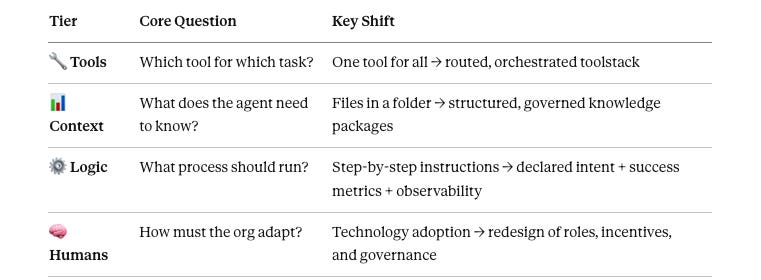
Each tier builds on the ones below it. You need the right tools to make context useful, the right context to fuel effective workflows, and well-designed workflows to create the conditions under which human and organizational adaptation can actually happen.
Prompt engineering got us started. But the agent era rewards system designers.
The question is no longer “can you use AI?” It’s: can you architect the environment where AI safely creates value?
Here is a scorecard to help you answer that question.
AI‑Native Stack Scorecard (5 minutes)
Score each 0–2 (0 = not true, 1 = partially, 2 = consistently true). Total / 24.
Tier 1 — Tools (Selection & Orchestration)
We have task-to-tool routing rules (small model vs frontier, local vs cloud, tool vs model).
Every tool has an owner, cost profile, and risk classification.
We can run agents in sandboxed environments with least-privilege permissions.
Tier 2 — Context (Context Engineering & Data Readiness)
4) We have a single “source of truth” for definitions, policies, and constraints.
5) Context is versioned (what changed, when, and why) and portable across teams.
6) Sensitive data access is enforced by role, with clear logging.
Tier 3 — Logic (Workflow Engineering)
7) For each workflow, we define success metrics before deployment.
8) We have observability (logs, traces, error handling, escalation paths).
9) We can inspect and audit what the agent did and why.
Tier 4 — Humans (Culture & Org Redesign)
10) Leaders have hands-on usage habits (not “AI theater”).
11) Accountability is explicit (who owns decisions when AI acts).
12) Reskilling + change management is funded like a core program, not a side quest.
Interpretation
0–8: You are in experimentation; constrain autonomy, prioritize literacy + data hygiene.
9–16: You are in pilot; focus on guardrails + metrics + workflow visibility.
17–24: You are in scaling; prioritize cross-functional coordination and governance.
Diego Soroa is Academic Director of IE Edge Lab for Radical Thinking and Disruptive Innovation at IE Business School, where he teaches Generative AI Strategy. He has participated in enterprise AI transformations and trainings for organizations including Santander, Meta, EY, IKEA, and Inditex.